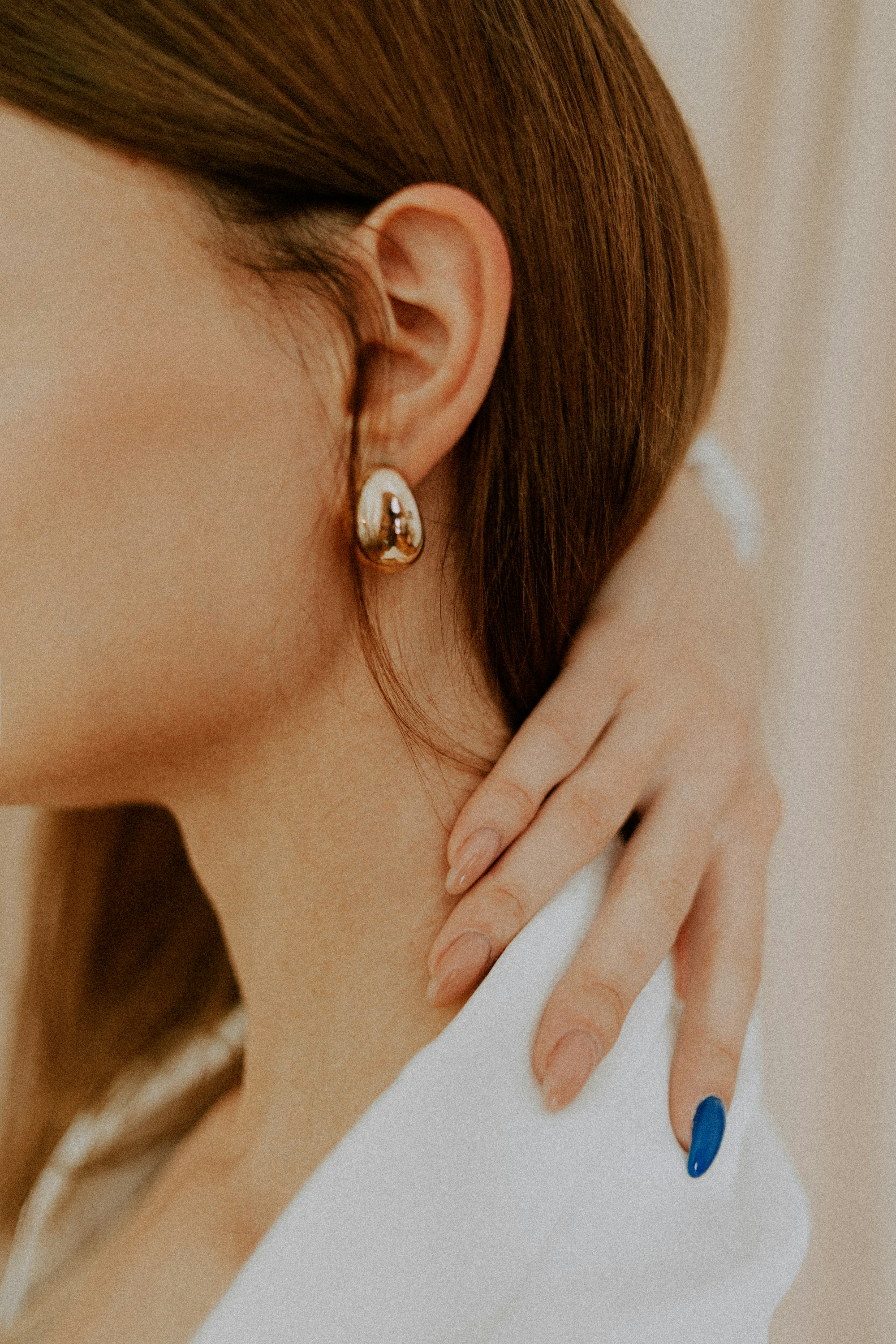
Every serious jewelry wardrobe begins with a pair of diamond studs. They are the piece worn to the office, on the plane and at the gala, often by the same woman on the same day, which is exactly why they reward careful buying. A good pair is less about the biggest number on the tag and more about how two small stones behave together, a few millimeters from the face.
At a glance
- Carat math: “1 ct tw” means two stones of roughly 0.50 ct each, not a carat per ear.
- Natural, 1 ct tw: $1,995 at Brilliant Earth (G/H, SI, 18k) and $3,930 at Blue Nile (H-I, SI1-SI2, 14k) at the time of writing.
- Lab-grown, 1 ct tw: $637 to $895 for F-G, VS-range pairs.
- Natural, 2 ct tw: $13,030 at Blue Nile versus $1,730 for a lab-grown pair.
- Tiffany Solitaire: from $1,450 for 0.22 ct tw in platinum.
- Priorities: cut and matching first, then color, with clarity the easiest place to save.
What does “total carat weight” mean for stud earrings?
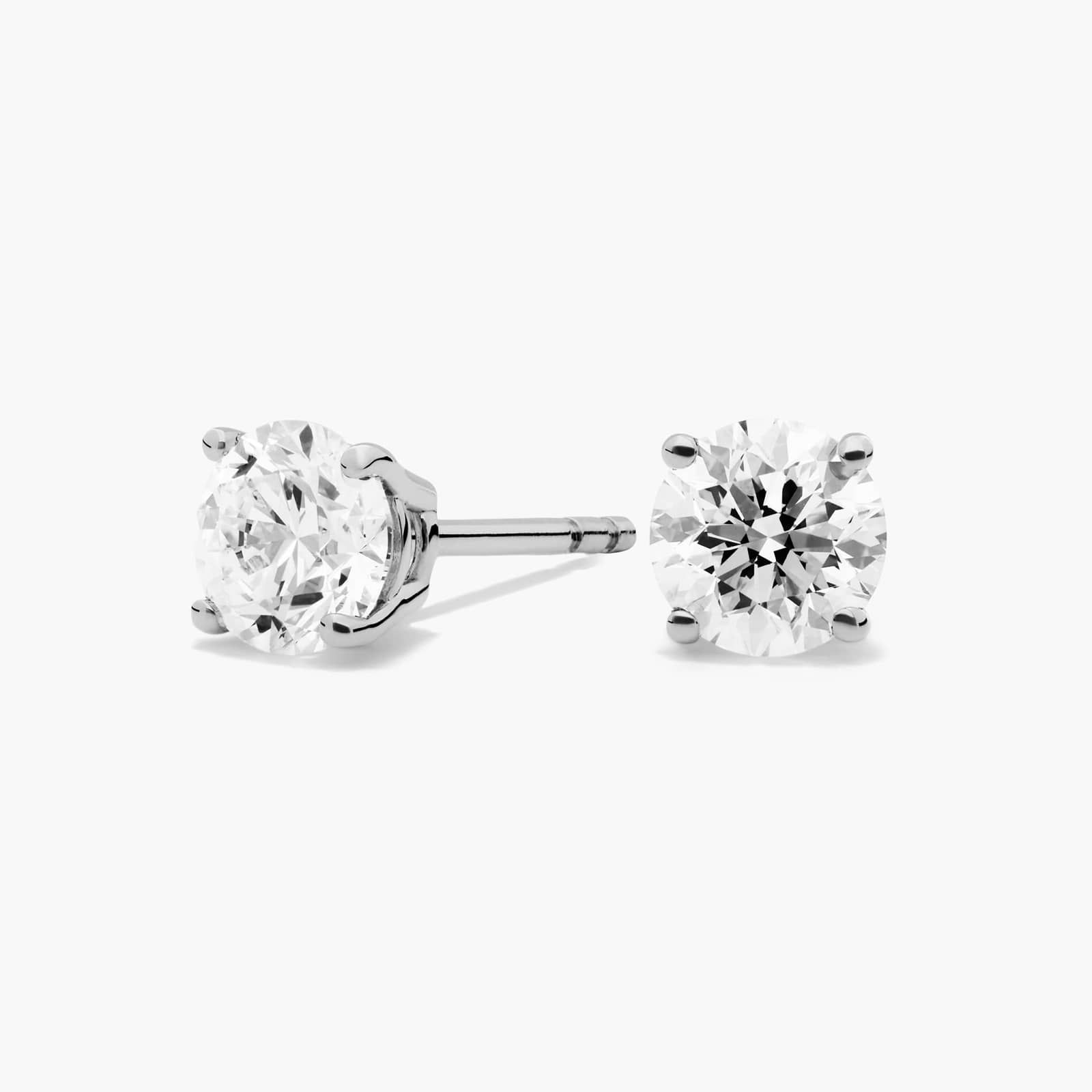
Stud earrings are almost always sold by total carat weight (ct tw), the combined weight of both diamonds. Divide by two to know what sits on each ear. A 1 ct tw pair carries two stones of about half a carat; a 2 ct tw pair, two one-carat stones. Retailers also round: Brilliant Earth’s 1 ct tw pairs weigh 0.95 to 0.96 ct in total, which is normal but worth knowing.

In practice, size on the ear grows more slowly than weight. As a rough guide for a well-cut round brilliant, a 0.25 ct stone measures about 4.1 mm across, a 0.50 ct about 5.1 mm and a 1 ct about 6.4 mm. That means a 0.5 ct tw pair reads as a quiet, everyday sparkle; 1 ct tw is the classic size most people picture, visible across a dinner table without announcing itself; and 2 ct tw is a clear statement, noticeable at a distance and noticeably heavier on the lobe.
How much do diamond stud earrings cost in 2026?

Prices below come from retailer and brand product pages at the time of writing, all for round diamonds in prong settings unless noted. The gap between natural and lab-grown, already familiar from our lab-grown vs natural price report, widens sharply as the stones get bigger.
| Pair | Total weight | Quality | Metal | Price |
|---|---|---|---|---|
| Blue Nile natural | 1/2 ct | H-I, I1 | 14k white | $1,090 |
| Blue Nile natural | 1 ct | H-I, SI1-SI2 | 14k white | $3,930 |
| Brilliant Earth natural | 0.96 ct | G/H, SI | 18k white | $1,995 |
| Blue Nile lab-grown | 1 ct | F-G, VS2-SI1 | 14k white | $637 (sale; was $910) |
| Brilliant Earth lab-grown | 0.96 ct | F/G, VS | 18k white | $895 |
| Blue Nile natural | 1 1/2 ct | H-I, SI1-SI2 | 14k white | $7,770 |
| Blue Nile natural | 2 ct | H-I, SI1-SI2 | 14k white | $13,030 |
| Blue Nile lab-grown | 2 ct | F-G, VS2-SI1 | 14k white | $1,730 |
| Tiffany Solitaire | 0.22 ct | Matched, not stated | Platinum | $1,450 |
| Tiffany Solitaire | 0.31 ct | D-J, IF-SI1 | Platinum | $2,200 |
Two readings stand out. Doubling from 1 to 2 ct tw more than triples the natural price at Blue Nile, because one-carat stones are rarer than half-carats and priced per carat accordingly. And a Tiffany pair costs several times what an unbranded pair of similar weight does; you are paying for the house’s own grading, matching and the blue box. A Cartier price is not included because we could not verify one from the maison’s site at the time of writing.
Which of the 4Cs matter most for diamond studs?

Studs are judged from conversational distance, never under a loupe, which changes the usual order of the 4Cs. Cut comes first: it decides how much light a small stone throws back, and a poorly cut diamond looks smaller and duller from every angle. Matching comes second. The two stones should agree in diameter, color and brightness, because the eye reads them as a pair, and a mismatch is far more visible than a single grade step.
Color is the next lever. In white metal, G to H looks white on the ear; I can work in yellow gold, which warms everything around it. Clarity is where studs forgive the most. An SI1 or SI2 stone that is “eye-clean” will look identical to a VS once it is on the lobe, which is why we would spend on cut and color before clarity. Be more cautious with I1, the grade on Blue Nile’s lowest-priced natural pairs: some inclusions in that range can be seen without magnification and can dim sparkle.
Which diamond shape is best for stud earrings?
Round brilliants remain the default for good reason: they return the most light and are the easiest to match. Princess cuts give a crisp, modern square and tend to cost less per carat, but their sharp corners need protective prongs. Ovals look larger than rounds of the same weight and lengthen the face slightly; just make sure both stones point the same way and share a similar length-to-width ratio. Our diamond shapes guide covers each cut in more depth.
Which setting and backs should you choose?
Four-prong is the classic: secure, minimal and slightly square in outline. Three-prong martini, a cone-shaped mount with three claws, uses less metal and sits closer to the ear; Brilliant Earth’s lab-grown martini pair is $895 for 0.95 ct tw. A basket setting supports the stone from below and lets light in from the sides. A bezel wraps the stone in a thin rim of metal, the most protective option and the most modern-looking, though it hides a little of the diamond; Brilliant Earth’s 1/2 ct tw lab bezel studs in 14k yellow gold are $795. A halo rings the center stone with small diamonds to make it look larger, as in Blue Nile’s 1 ct tw halo studs, on sale for $1,970 at the time of writing.
Backs deserve as much thought as stones. Push backs, or friction backs, are the simplest and the most likely to loosen over time. Screw backs twist onto a threaded post and are very secure, but slower to fasten. Guardian backs, now standard on many Blue Nile and Brilliant Earth pairs, are a larger push back with an extra grip on the post. La Pousette backs use a small spring lock that you release by squeezing two side tabs, giving screw-back security with push-on ease. For anything over 1 ct tw, we would choose screw or locking backs.
Which metal is best for diamond studs?
Platinum is dense, naturally white and holds prongs firmly, which is why Tiffany sets its Solitaire studs in it. 18k white gold is a refined middle ground; 14k white gold is harder and less expensive, but both are rhodium-plated and will need replating over the years. Yellow and rose gold are a fashion choice that flatters warmer diamonds. Gold content also moves the price; see our gold price report.
How do you buy a well-matched pair?
Ask for the measurements of each stone, not just the total weight; diameters within a few hundredths of a millimeter are ideal. Ask how color and clarity are stated. Many pre-set studs list a range, such as H-I or SI1-SI2, which means the stones fall somewhere within it rather than sharing an exact grade. For larger pairs, consider choosing two loose diamonds with grading reports and having them set, which lets you match cut, color and diameter precisely. Tiffany says it records certification details for its diamonds of 0.18 ct and above.
Do diamond studs need insurance and certification?
Yes, once they cost more than you could comfortably replace. Studs are the jewelry most often lost, usually one earring at a time. Keep the receipt and any grading reports, get an independent appraisal for pairs above a few thousand dollars, and add them to a personal articles policy or jewelry rider. Have a jeweler check prongs and backs once a year. For lab-grown stones, insure at replacement cost rather than original price, since lab-grown prices have been falling.
Where did the diamond stud come from?
Gem earrings are ancient, but the single-diamond stud as we know it is a modern idea. It depended on two developments: the round brilliant cut, whose proportions were set out by Marcel Tolkowsky around 1919, and the return of pierced ears. In the early twentieth century many fashionable women in the West wore screw-on or clip earrings that needed no piercing; piercing came back into fashion in the United States around the 1960s and 1970s. As it did, a pair of solitaire studs became a standard milestone gift and, eventually, the most widely worn piece of diamond jewelry after the engagement ring. The details of that timeline vary by source, but the arc is clear: the stud is the twentieth century’s quiet diamond.
A pair of studs is judged as one jewel, so the best money goes into how well the two stones agree.
Frequently asked questions
Is a 1 carat diamond stud 1 carat per ear?
Usually not. “1 ct tw” means one carat across both earrings, so roughly 0.50 ct per ear; for one carat per ear, look for 2 ct tw.
How much are 1 carat diamond studs in 2026?
At the time of writing, natural 1 ct tw pairs were $1,995 at Brilliant Earth and $3,930 at Blue Nile, while lab-grown equivalents were $637 to $895.
What is the most secure earring back for diamond studs?
Screw backs and locking backs such as La Pousette are the most secure. Push backs are the easiest to lose.
What color and clarity should diamond studs be?
G to H color and eye-clean SI clarity are the sweet spot for white metal, with an excellent cut and closely matched stones mattering more than higher grades.
Sources: Blue Nile · Brilliant Earth · Tiffany & Co. · Robinson’s Jewelers on La Pousette backs
Shop the story
- 1/2 carat natural diamond studs at Blue Nile
- 1 carat natural diamond studs at Blue Nile
- 1 carat lab-grown diamond studs at Blue Nile
- All diamond stud earrings at Blue Nile
The Carat Post is a Blue Nile affiliate partner and may earn a commission when you buy through these links, at no extra cost to you. Product images courtesy of Blue Nile.