The Carat Post independently selects every recommendation. If you purchase through certain links, we may earn a commission at no additional cost to you. Affiliate relationships do not determine our editorial conclusions.
Why trust this recommendation?
Every piece here is chosen by Karina, who has spent 11 years in fine watches and is studying gemology with GIA. Picks are judged from the retailer’s published specifications: stone, grading, setting, metal and price.
Prices were checked on the date shown in the article and can change. Specifications come from the retailer’s listing; nothing is estimated.
The Carat Post is independent and is not affiliated with GIA, Blue Nile or any jewelry house. Read our editorial standards.
Five thousand dollars buys a beautiful ring, but only if you ask the right questions first. In short: before you pay, get the grading report number and check it on the lab’s website, insist on the top cut grade for a round stone, read the return, resizing and upgrade terms in writing, and settle her ring size and metal yourself. At $5,000 the setting should take roughly $870 to $1,180 and the diamond the rest.
At a glance
- The short answer: ask for a GIA or IGI report, the cut grade, the return window and the resizing terms before you pay.
- Setting at $5,000: $870 (14K gold) to $1,180 (platinum) for a classic four-prong solitaire at Blue Nile.
- Diamond budget: about $3,800 to $4,100. The median 1.00–1.24 ct natural round lists at $3,733 across tracked retailers (October 2026).
- Returns: Blue Nile allows 30 days from shipment; engraved or resized pieces cannot be returned.
- Insurance: about 1–2% of appraised value a year, so $50 to $100 on a $5,000 ring.
Which grading report should the diamond have?
Ask the retailer one plain question: which lab graded this stone, and what is the report number? A report from GIA or IGI can be looked up on the lab’s own website, and the laser inscription on the girdle should match it. Blue Nile’s own upgrade program accepts only colorless diamonds with an IGI or GIA report, which tells you how much weight the trade itself places on that document. If a listing does not name the lab, ask for the report before you buy, not after.
- Which lab issued the report, and can I see it before paying?
- Is the report number inscribed on the stone?
- For a lab-grown diamond: does the report state that it is laboratory-grown?
Does the cut grade matter at $5,000?
More than anything else. GIA puts it directly: the beauty of a diamond “depends more on cut quality than anything else.” Its cut scale runs from Excellent to Poor and applies to standard round brilliants in the D-to-Z range. For a round stone, ask for Excellent and do not trade it away for a better color or clarity grade you will never see. Fancy shapes such as ovals and pears do not receive that GIA cut grade, so ask instead for the length-to-width ratio, the depth and table percentages, and a video that shows whether a dark bow-tie crosses the center.
What return, upgrade and resizing policy should you expect?
Get every answer in writing. As a benchmark, Blue Nile offers 30 days from the shipment date, with a fully insured return label, and limits customers to two complimentary returns a year. Engraved, personalized, custom, clearance and resized pieces cannot be returned at all, so engrave and resize only once you are certain.
Ask about upgrades too. Blue Nile’s lifetime upgrade program credits 100% of the original diamond price, but the new diamond must cost at least twice as much, the stone must be returned undamaged with its original report, and engraved or resized items are excluded. Ask whether the setting can be reused, and whether a natural stone can be traded for lab-grown or the reverse.
- How many days is the return window, and does it start at purchase or at shipment?
- Is the first resize free? Blue Nile offers one free resize within 6 months of purchase, up or down within two sizes (Blue Nile, checked October 11, 2026), return shipping included.
- Can this specific ring be resized? Blue Nile states that eternity rings, milgrain and ornate bands cannot.
What does the warranty actually cover?
Warranties differ more than return windows. Blue Nile’s Limited Lifetime Warranty covers free cleaning, inspections, prong tightening, resizing and repairs for manufacturing defects, and the retailer recommends an inspection every six months. Note the word “manufacturing”: a warranty of this kind does not replace insurance against loss or theft. Ask what happens if a stone falls out, whether rhodium replating on white gold is included, and who pays shipping each way.
What should you ask yourself: ring size, metal and lead time?
Ring size. Borrow a ring she wears on the same finger and have it measured, or ask someone close to her. A solitaire can usually be resized, but each resize after the first may cost extra and ends any chance of a return.
Metal. Platinum costs more: Blue Nile’s Classic Four Prong Solitaire is $1,180 in platinum and $870 in 14K yellow gold. That $310 difference is money that could go into the diamond. Yellow gold is also forgiving of a slightly warmer color grade; white metals show color more readily.
Lead time. Work backward from the date you plan to propose. Ask the retailer for a written ship date for the finished ring, not just for the diamond, and leave room for a resize or return before the moment arrives. Blue Nile ships US orders over $500 overnight once the ring is ready.
How should you split a $5,000 ring budget?
Choose the setting first, because it is a fixed, known price, then give everything else to the center stone. Here is how $5,000 divides with a classic four-prong solitaire.
| Line | 14K gold build | Platinum build | Basis |
|---|---|---|---|
| Setting | $870 | $1,180 | Blue Nile Classic Four Prong Solitaire, Oct 11, 2026 |
| Center diamond | $4,130 | $3,820 | Remainder of budget |
| Ring total | $5,000 | $5,000 | |
| First-year insurance (separate) | $50–$100 | $50–$100 | 1–2% of appraised value a year (Blue Nile) |
For context, a 1.00–1.24 carat natural round lists between about $450 and $16,141 across retailers tracked by CaratRadar, with a median of $3,733 as of October 2026. A diamond budget of $3,800 to $4,100 therefore sits right in the middle of the one-carat natural market. In lab-grown, the median 1-carat oval is $592, which leaves room for a larger stone or a more elaborate setting.
Natural or lab-grown at $5,000?
| Natural | Lab-grown | |
|---|---|---|
| Median 1 ct price (Oct 2026) | $3,733 (round) | $592 (oval) |
| What $5,000 buys | About 1 ct center in a simple setting | A larger center, or a multi-stone design |
| Upgrade at Blue Nile | Like-for-like, at 2x price | Like-for-like, at 2x price |
| Best for | Rarity and tradition | Size and grade for the money |
The best question is the one that is answered in writing.
The editor’s recommendation
In our view, the strongest $5,000 ring is a well-cut stone in a plain, well-made solitaire. Spend $870 to $1,180 on a classic four-prong setting, choose the metal she already wears, and put the remaining $3,800 to $4,100 into a natural round of Excellent cut with an eye-clean clarity and a GIA or IGI report you have verified. If size matters more to you than rarity, a lab-grown stone will go much further. Either way, confirm her ring size before engraving anything, and keep the box and report until the return window has closed.
Buying mistakes to avoid
- Paying before you have seen the grading report and checked its number online.
- Trading cut grade for a higher color or clarity grade you will not see.
- Engraving or resizing inside the return window, which ends your right to return.
- Choosing an eternity band when you are not sure of her size; most cannot be resized.
- Assuming the warranty covers loss. It covers manufacturing defects; insurance covers loss and theft.
A practical checklist
- Report lab and number, verified on the lab’s website.
- Cut grade (Excellent for rounds) or proportions and video for fancy shapes.
- Return window in writing, and what voids it.
- Resizing: is this ring resizable, and is the first resize free?
- Warranty: what it covers, and how often inspections are offered.
- Upgrade terms: credit, minimum new price, exclusions.
- Ring size and metal confirmed; written ship date that leaves time to spare.
- Itemized receipt and appraisal for insurance.
Frequently asked questions
Is $5,000 enough for a one-carat diamond ring?
Yes, for many stones. The median 1.00–1.24 carat natural round lists at $3,733 (October 2026), which fits beside an $870 to $1,180 setting.
How long do I have to return an engagement ring?
It depends on the retailer. Blue Nile allows 30 days from shipment, but not for engraved, resized, custom or final-sale pieces.
What if I get the ring size wrong?
Most solitaires can be resized; Blue Nile offers one free resize within 6 months of purchase, within two sizes (Blue Nile, checked October 11, 2026). Eternity rings and ornate bands usually cannot, so be certain before choosing one.
The Carat Post selection
Affiliate links: The Carat Post may earn a commission if you buy through these links, at no extra cost to you. Specifications are as listed on Blue Nile; judged from published specifications, not inspected in person.
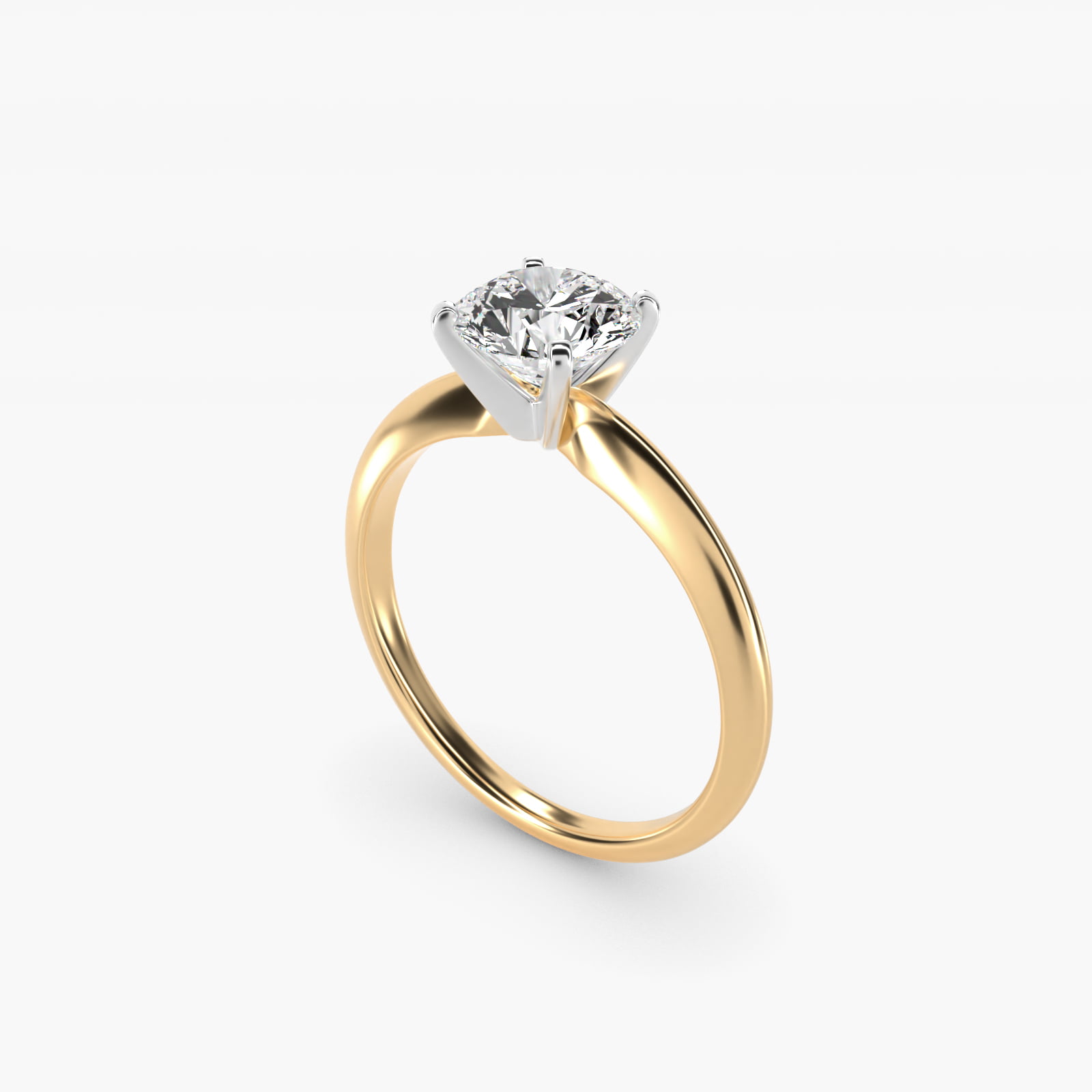
Classic Four Prong Solitaire Engagement Ring in 14K Yellow Gold — $870 (setting price). 14K yellow gold, 1.90 mm band; center diamond chosen separately. Price checked October 11, 2026. Why: the lowest-cost route to a classic solitaire, leaving the most for the stone. View at Blue Nile
Classic Four Prong Solitaire Engagement Ring in Platinum — $1,180 (setting price). Platinum, 1.90 mm band; takes center stones from 0.20 to 8.00 carats. Price checked October 11, 2026. Why: the same timeless design in the more durable white metal. View at Blue Nile
Five-Stone Graduated Oval Lab-Grown Diamond Ring in Platinum, 3 ct tw — $5,550. Lab-grown ovals, 3 ct total weight with a 1 ct center; F–G color, VS2–SI1 clarity (averages); platinum, 2.00 mm band. Price checked October 11, 2026. Why: just over budget, but shows how far lab-grown stretches $5,000. View at Blue Nile
Related reading
- Best Engagement Rings From $5,000–$10,000
- How Much Does an Engagement Ring Cost in 2026?
- The 4Cs of Diamonds Explained
- Lab-Grown vs Natural Diamonds: 2026 Prices
- Engagement Ring Styles: Solitaire, Halo, Three-Stone
- The Best Fine Jewelry From $5,000–$10,000 · All buying guides
Considering a piece in this price range? Send Karina the link and your priorities for an independent second look.
Ask KarinaSources: GIA, Diamond Cut · Blue Nile Returns Policy · Blue Nile Services · Blue Nile, Free Resizing · Blue Nile Diamond Upgrade Program · Blue Nile, Engagement Ring Insurance · CaratRadar, 1 ct natural round prices · CaratRadar, 1 ct lab-grown oval prices