The Carat Post independently selects every recommendation. If you purchase through certain links, we may earn a commission at no additional cost to you. Affiliate relationships do not determine our editorial conclusions.
Why trust this recommendation?
Every piece here is chosen by Karina, who has spent 11 years in fine watches and is studying gemology with GIA. Picks are judged from the retailer’s published specifications: stone, grading, setting, metal and price.
Prices were checked on the date shown in the article and can change. Specifications come from the retailer’s listing; nothing is estimated.
The Carat Post is independent and is not affiliated with GIA, Blue Nile or any jewelry house. Read our editorial standards.
The most expensive diamond is rarely the most beautiful one. The short answer: spend on cut, which GIA calls the factor that fuels a diamond’s fire, sparkle and brilliance; spend the time to get a verifiable grading report; and save on clarity, color and the last few points below a round carat weight. On Blue Nile on October 11, 2026, two GIA-graded 1.50-carat natural rounds, both with Excellent cuts, were priced at $19,957 (D, Internally Flawless) and $9,696 (F, VS1). The difference between them is defined under 10x magnification.
At a glance
- Spend on: cut (Excellent for a round) and a GIA or IGI report you can verify.
- Save on: clarity (VS2–SI1, eye-clean) and color (G–H in white metal, in our view).
- Carat: GIA notes up to a 20% price difference for a 6-point difference in weight around magic sizes.
- Setting: a classic solitaire from $1,000 in 14K white gold on Blue Nile.
- Biggest single saving: lab-grown. A 2 ct D–F, VS platinum solitaire was $3,040.
Why should cut come first?
GIA is unusually direct on this point: “The allure and beauty of a particular diamond depends more on cut quality than anything else.” Its cut grade runs from Excellent to Poor and reflects brightness (the total light reflected), fire (light dispersed into spectral colors) and scintillation (the pattern of light, dark and flashes). Higher color and clarity grades cannot rescue a poorly cut stone, but a well-cut stone makes modest grades look their best. For a round, buy Excellent. For fancy shapes, Blue Nile listings show cut grades such as Ideal and Very Good, and the price gap can be small: a 1.00 ct G VS2 oval graded Very Good was listed at $3,392, a larger 1.19 ct H VS1 oval graded Ideal at $3,918.
Where should the money go? A budget breakdown
| Factor | Spend or save | Price example (Blue Nile, Oct 11, 2026) |
|---|---|---|
| Cut | Spend: Excellent for rounds | Every round example below is graded Excellent |
| Clarity | Save: VS2–SI1, eye-clean | 1.50 ct round: D IF $19,957; F VS1 $9,696; E SI1 $8,513 |
| Color | Save: G–H in white metal | 1 1/2 ct G–H SI natural solitaire, platinum: $9,120 |
| Carat | Save: stop just short of magic sizes | Same solitaire, G–H SI: 1 ct $3,600 vs 1 1/2 ct $9,120 |
| Report | Spend time, not money | Loose stones list a GIA report; preset pages we checked do not name the lab |
| Setting | Save: simple solitaire | Petite Solitaire: $1,000 in 14K white gold, $1,330 in platinum |
| Origin | Save: lab-grown | 2 ct lab-grown D–F VS solitaire, platinum: $3,040 |
What are the color and clarity sweet spots?
Clarity is where the largest sums disappear for the least visible return. GIA grades clarity at 10x magnification: VS1 and VS2 inclusions “are observed with effort but can be characterized as minor,” SI1 and SI2 inclusions “are noticeable,” and GIA adds that many inclusions “are not visible to the naked eye.” The goal is an eye-clean stone, one with nothing visible face-up at a normal distance. In our view, VS2 and SI1 are the sweet spot, with one condition: an SI1 must be checked on video, stone by stone.
| 1.50 ct natural round, GIA, Excellent cut | Color | Clarity | Price |
|---|---|---|---|
| Stock 27909232 | D | Internally Flawless | $19,957 |
| Stock 29333049 | F | VS1 | $9,696 |
| Stock 29922631 | E | SI1 | $8,513 |
Color follows the same logic, more gently. GIA notes that “subtle differences in color can dramatically affect diamond value.” In platinum or white gold we would stay at G or H; in yellow gold, the warm metal is forgiving and a lower color grade is a reasonable saving.
Pay for what the eye sees: cut first, everything else second.
What are magic sizes, and how do you use them?
GIA calls the half carat, three-quarter carat and one carat “magic sizes,” weights at which the price per carat rises. Its example: a stone just over one carat “can give it as much as a 20 percent difference in price with only a 6-point difference in weight,” even though “the visual difference between a 0.98-carat diamond and a 1.01-carat diamond is negligible.” Larger steps compound the effect. Blue Nile’s natural Petite Solitaire in platinum, at the same G–H, SI averages, cost $3,600 with a 1 ct center and $9,120 with 1 1/2 ct: half again the weight for about two and a half times the price. In practice, ask to see stones just below the threshold, for example 0.90–0.99 ct rather than 1.00, and compare the measurements on the report.
Does the certificate matter?
It is the one thing you should never economize on, and it costs nothing but attention. The loose Blue Nile diamonds cited here each carry a GIA grading report with its own number. The preset rings we checked describe grades as averages (“G–H,” “SI”) and do not name the grading lab on the page. That does not make them poor value, but ask for the report before you buy and verify the number on the lab’s website.
How much should go to the setting?
Less than most people expect. Blue Nile notes that a simple solitaire needs less stone-setting work than a halo, pavé or three-stone design; its Petite Solitaire costs $1,000 in 14K white gold and $1,330 in platinum. Platinum is where we would spend: The Knot calls it the more durable metal, and white gold’s rhodium plating needs renewing every one to three years.
The editor’s recommendation
In our view, set your priorities in this order: cut, then carat weight just under a magic size, then color, then clarity, with eye-clean as the only clarity test that matters. Applied to the 1.50 ct rounds above, we would choose the E, SI1 at $8,513 over the F, VS1 at $9,696, provided its video shows nothing face-up, and put the $1,183 difference toward a platinum setting. Note that the F, VS1 lists strong fluorescence and the E, SI1 faint; view both in daylight video before deciding. If size matters more than rarity, lab-grown is the largest saving of all.
Buying mistakes to avoid
- Trading cut for color or clarity. GIA ties beauty to cut above everything else.
- Paying for Flawless or Internally Flawless in a solitaire. On the 1.50 ct rounds above, it doubled the price.
- Buying SI clarity unseen. SI inclusions are “noticeable” at 10x; only a video tells you whether they show to the eye.
- Insisting on exactly 1.00 or 2.00 carats. A stone just under looks the same and can cost far less.
- Accepting a preset stone without a named report. Ask which lab graded it.
A practical spend-and-save checklist
- Round: Excellent cut grade, no exceptions.
- Fancy shape: check the listed cut grade, the proportions and the bow-tie on video.
- Clarity: VS2 or SI1, confirmed eye-clean.
- Color: G–H in white metal; lower is reasonable in yellow gold.
- Carat: search just below 0.50, 0.75, 1.00, 1.50 and 2.00.
- Report: GIA or IGI, number verified on the lab’s site.
- Setting: a plain solitaire; platinum if the budget allows.
- Check fluorescence on the report and view the stone in daylight.
Frequently asked questions
Which of the 4Cs matters most?
Cut. GIA says a diamond’s beauty “depends more on cut quality than anything else.”
What does eye-clean mean?
No inclusion visible face-up without magnification. It is not a lab grade, so confirm it with the retailer’s video or in person.
Is a 0.90-carat diamond much smaller than a 1-carat?
Only slightly. GIA describes the visual difference between 0.98 and 1.01 carats as negligible, while the price gap can reach 20 percent.
The Carat Post selection
Affiliate links: The Carat Post may earn a commission from Blue Nile at no extra cost to you. Specifications are as listed on each Blue Nile page; pieces were not inspected in person.
GIA 1.50 Carat E-SI1 Excellent Cut Round Natural Diamond — $8,513 (diamond only). Natural, GIA report, Excellent cut, 7.33 x 7.36 x 4.48 mm, faint fluorescence, stock 29922631. Price checked October 11, 2026.
Why: the save-on-clarity choice, provided the video shows it eye-clean.
View at Blue Nile
GIA 1.50 Carat F-VS1 Excellent Cut Round Natural Diamond — $9,696 (diamond only). Natural, GIA report, Excellent cut, polish and symmetry, 7.3 x 7.33 x 4.53 mm, strong fluorescence, stock 29333049. Price checked October 11, 2026.
Why: the safer clarity grade, at less than half the price of the D, IF equivalent.
View at Blue Nile
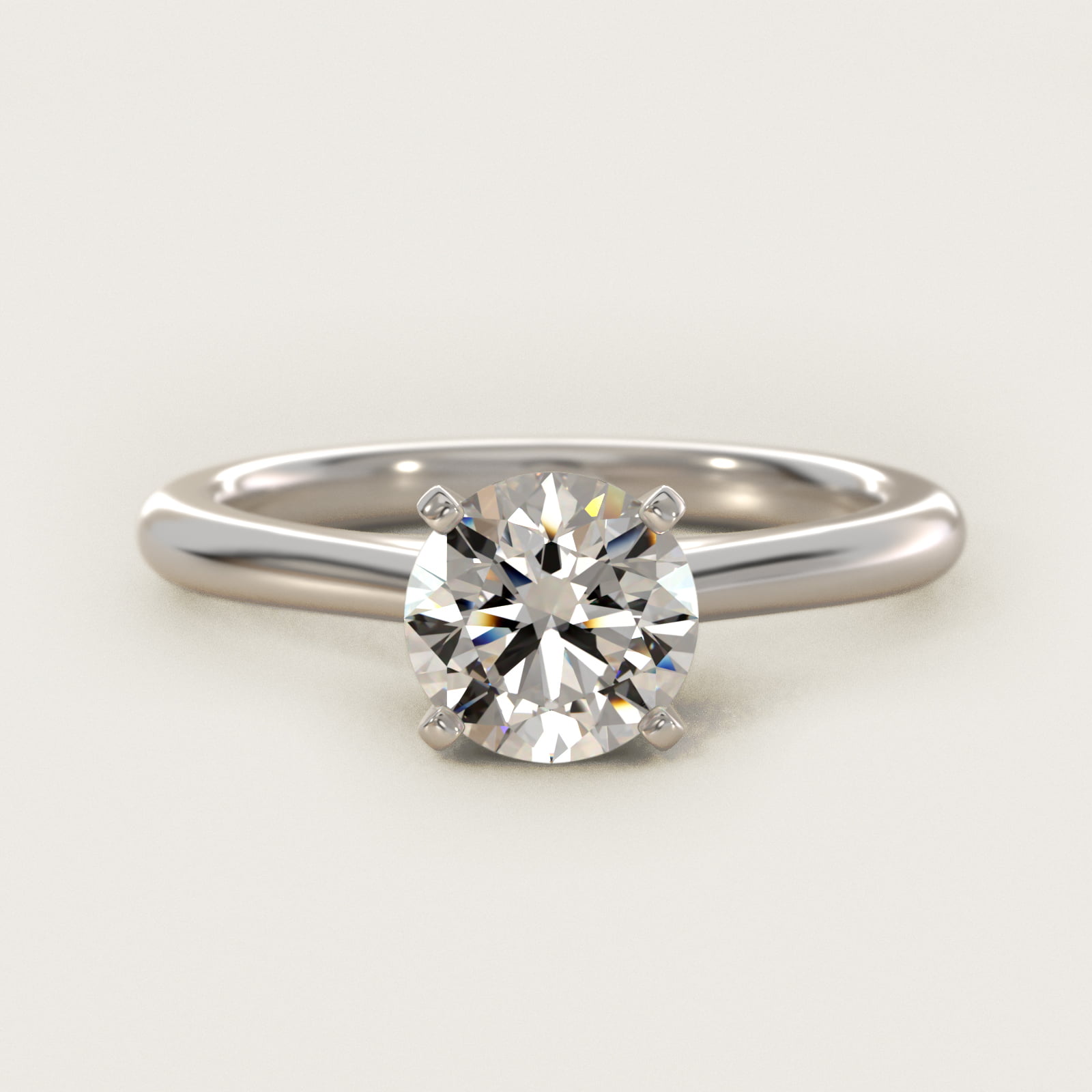
Petite Solitaire Engagement Ring in 14k White Gold — $1,000 (setting only). 14K white gold, 1.80 mm band. Price checked October 11, 2026.
Why: the save-on-setting choice that leaves the budget to the stone.
View at Blue Nile
Round 2 CT Certified Lab-Grown Diamond Petite Solitaire Engagement Ring in Platinum — $3,040. Lab-grown, 2 ct, D–F color, VS clarity (averages), platinum, 1.80 mm band; the page does not name the grading lab. Price checked October 11, 2026.
Why: the largest saving of all, with high color and clarity in platinum.
View at Blue Nile
Related reading
- Best engagement rings from $5,000–$10,000
- The 4Cs of diamonds explained
- Diamond shapes guide: round, oval, emerald, pear
- Lab-grown vs natural diamonds: 2026 prices
- How much to spend on an engagement ring in 2026
- Diamond stud earrings buying guide
- All buying guides
Considering a piece in this price range? Send Karina the link and your priorities for an independent second look.
Ask KarinaSources: Blue Nile 1.50 ct D IF · Blue Nile 1.50 ct F VS1 · Blue Nile 1.50 ct E SI1 · Blue Nile oval diamond listings · Blue Nile 1 ct natural solitaire · Blue Nile 1.5 ct natural solitaire · Blue Nile 2 ct lab-grown solitaire · Blue Nile Petite Solitaire, 14K white gold · Blue Nile Petite Solitaire, platinum · Blue Nile, engagement ring cost · GIA, cut · GIA, diamond quality factors · GIA, diamond clarity · The Knot, platinum vs white gold