Most diamonds are cut to return light. This one was carved to hold a gaze. GIA’s laboratory in Mumbai has examined “Jade Fang,” a 67.18-carat natural diamond sculpted and faceted into the face of a panther, with two small Zambian emeralds for eyes, and its findings, published in the Summer 2026 issue of Gems & Gemology, offer a rare look at a diamond treated as sculpture.
Shopping pre-loved? Discover authenticated pre-owned luxury, including pieces from houses such as Rolex, Cartier and Hermès, from What Goes Around Comes Around at Amazon Luxury Stores, a resale boutique that backs its pieces with its own authenticity guarantee. (Affiliate link: as an Amazon Associate we earn from qualifying purchases.)
At a glance
- The piece: “Jade Fang,” an opaque gray natural diamond carved and faceted as a panther’s face.
- Weight: 67.18 carats in total, carved from rough of 113 carats, according to the owner.
- Size: 28.45 × 24.17 × 11.37 mm.
- The eyes: two natural Zambian emeralds, marquise mixed cuts of 0.29 and 0.27 carats.
- The lab: GIA Mumbai identified it as a natural type Ia diamond; the study appears in Gems & Gemology, Summer 2026.

What is the Jade Fang carved diamond?
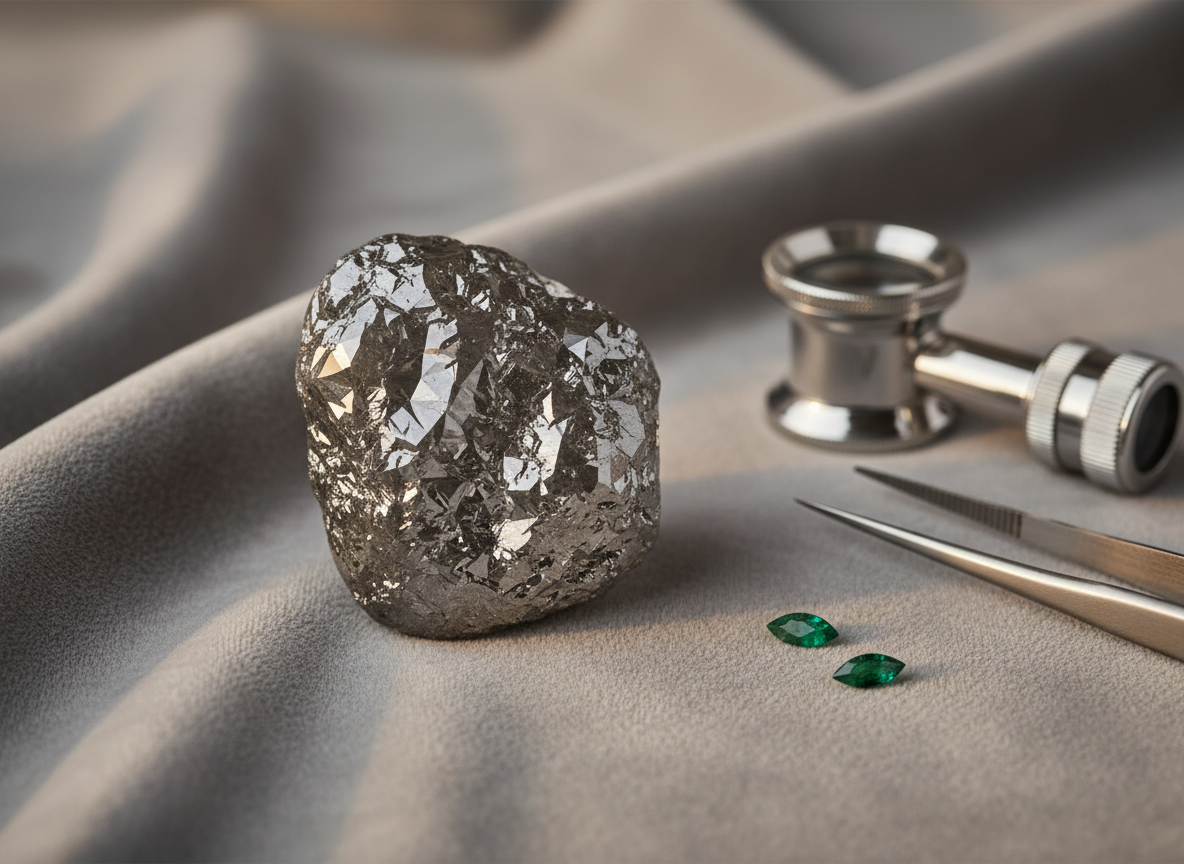
According to the GIA lab note, written by Roxane Bhot Jain and Manisha Bhoir of GIA Mumbai, the piece arrived as “an intriguing submission for an identification report.” It is an opaque gray stone, carved and faceted to suggest a panther’s face, with two green marquise stones set as eyes. The owner, who is not named, gave it the title Jade Fang and told the laboratory that it was carved from 113 carats of rough, losing roughly 40% of its weight along the way.
Rapaport, which reported the study on October 20, noted that the piece took nearly a year to complete. The rough was heavily included, and GIA writes that advanced cutting tools were needed to work around those inclusions and still give the face its contours.
How did GIA confirm it is a natural diamond?
An opaque gray carving does not look like a diamond to most eyes, so the laboratory relied on spectroscopy. Infrared absorption identified it as type Ia, the most common type of natural diamond, in which nitrogen atoms sit in clusters, and showed a hydrogen-related peak at 3107 cm⁻¹. Photoluminescence testing at room temperature revealed emissions tied to the N3 defect, another familiar signature of natural diamond. Under the microscope the stone was heavily included, but GIA found no major features reaching the surface, which matters for a carving with this many angles and edges.
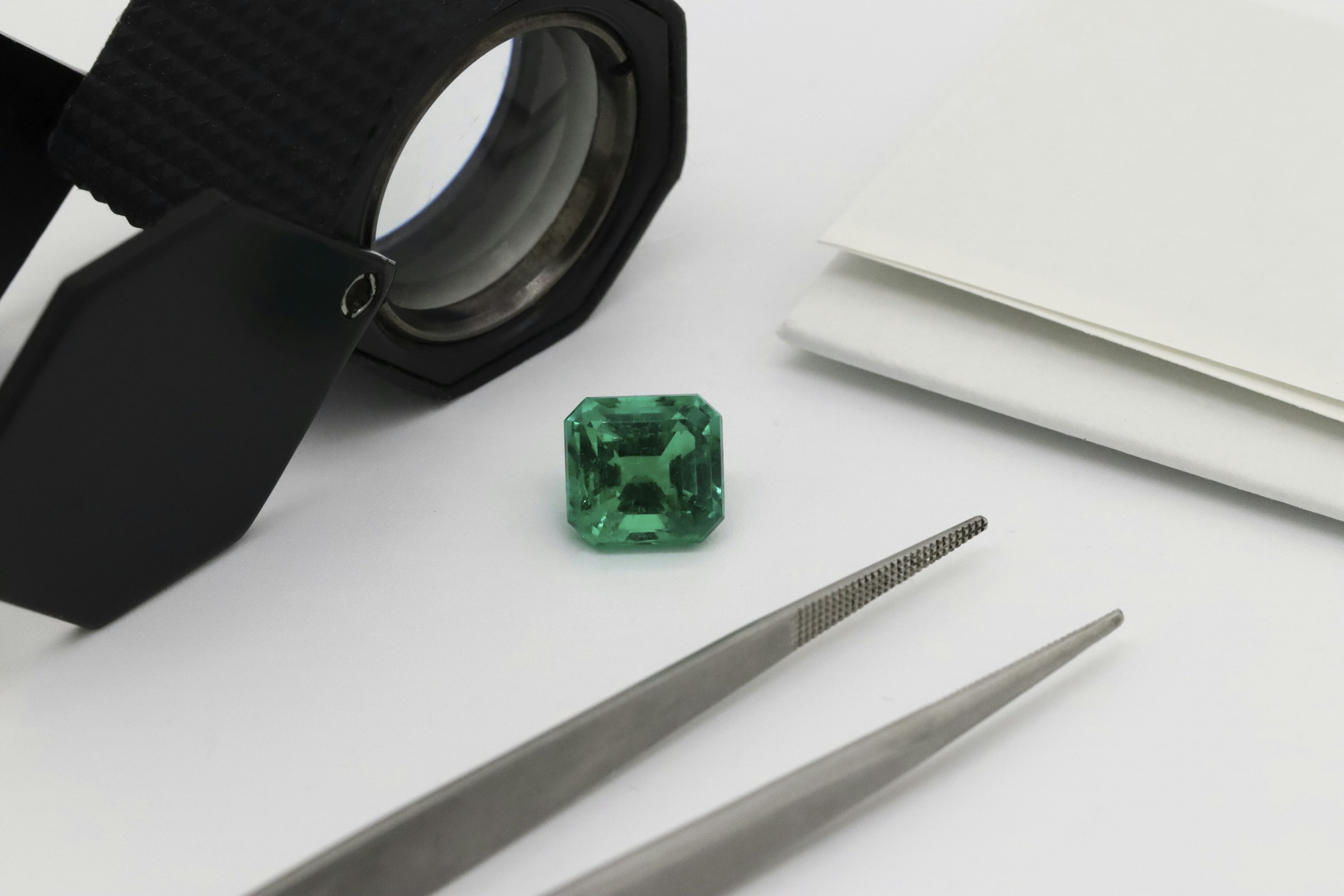
The emerald eyes were confirmed as natural Zambian emeralds of 0.29 and 0.27 carats. Both had been submitted to GIA before, a small detail that shows how carefully the owner documented each component.
Why are carved diamonds so rare? A short history
Diamond is the hardest natural material, and for most of history that made carving it close to impossible. The great historic exceptions come from Mughal India, where lapidaries engraved names onto the polished faces of large diamonds. The best-known example is the Shah diamond, now in Moscow’s Diamond Fund, which carries the inscribed names of three rulers. Those pieces were engraved, not sculpted into figures.
Modern lasers and precision polishing have changed what a cutter can attempt. Sculptural diamonds remain uncommon, though, because carving means giving up weight that could have been sold as polished carats. That trade-off is easier to make with heavily included or opaque rough, the same material behind the recent fashion for gray and “salt and pepper” diamonds. Jade Fang is a striking example: rough that would never have produced a classic white brilliant became a one-of-a-kind object instead. GIA puts it simply: “unique shapes such as this one challenge the cutter.”
A diamond that could never have been a classic brilliant became a sculpture instead.
How do you value a carved diamond?
No price or sale has been announced for Jade Fang, and carved diamonds have no price list. A conventional diamond is valued largely by the four Cs, while a carving is valued much more like a work of art: by the quality of the craftsmanship, the strength of the design, the rarity of the material and its documentation. GIA’s own conclusion points the same way, noting that “the true value of a diamond lies not just in its gemological characteristics.” In our view, that is the most useful line for collectors in the whole study.
For context on how extraordinary rough is followed from mine to market, see our reports on the 176-carat Owishi diamond from Namibia and the Arkansas diamond’s return home.
For the Collector
- Insist on an identification report. Opaque and carved stones are hard to judge by eye. A laboratory identification report confirming a natural diamond, as GIA issued here, should come with any carved piece; our guide to reading a GIA report explains what to look for.
- Document every component. Jade Fang’s emerald eyes were separately tested. Accent stones in a carving should be identified too, especially colored stones that may be treated.
- Check durability. Heavily included diamonds can be more vulnerable at thin edges. GIA’s note that there were no major surface-reaching features is the kind of comment to ask for.
- Value craftsmanship, not carats. Carat weight tells you little about a carving’s worth. Provenance, the carver’s identity and the quality of the finish weigh more, and resale markets for such pieces are thin. Past prices don’t predict future value.
Frequently asked questions
Is the Jade Fang panther face a real diamond?
Yes. GIA’s Mumbai laboratory identified it as a natural type Ia diamond using infrared and photoluminescence spectroscopy.
How big is the carved diamond panther face?
It weighs 67.18 carats and measures 28.45 × 24.17 × 11.37 mm, carved from rough the owner says weighed 113 carats.
Is Jade Fang for sale?
No sale or price has been announced; GIA examined it for an identification report, and the owner has not been publicly named.
Can a diamond be carved?
Yes, but rarely, because diamond’s hardness makes carving slow and costly; modern lasers and polishing tools make sculptural shapes more feasible than in the past.
Sources: GIA, Gems & Gemology Lab Notes, Summer 2026 · Rapaport